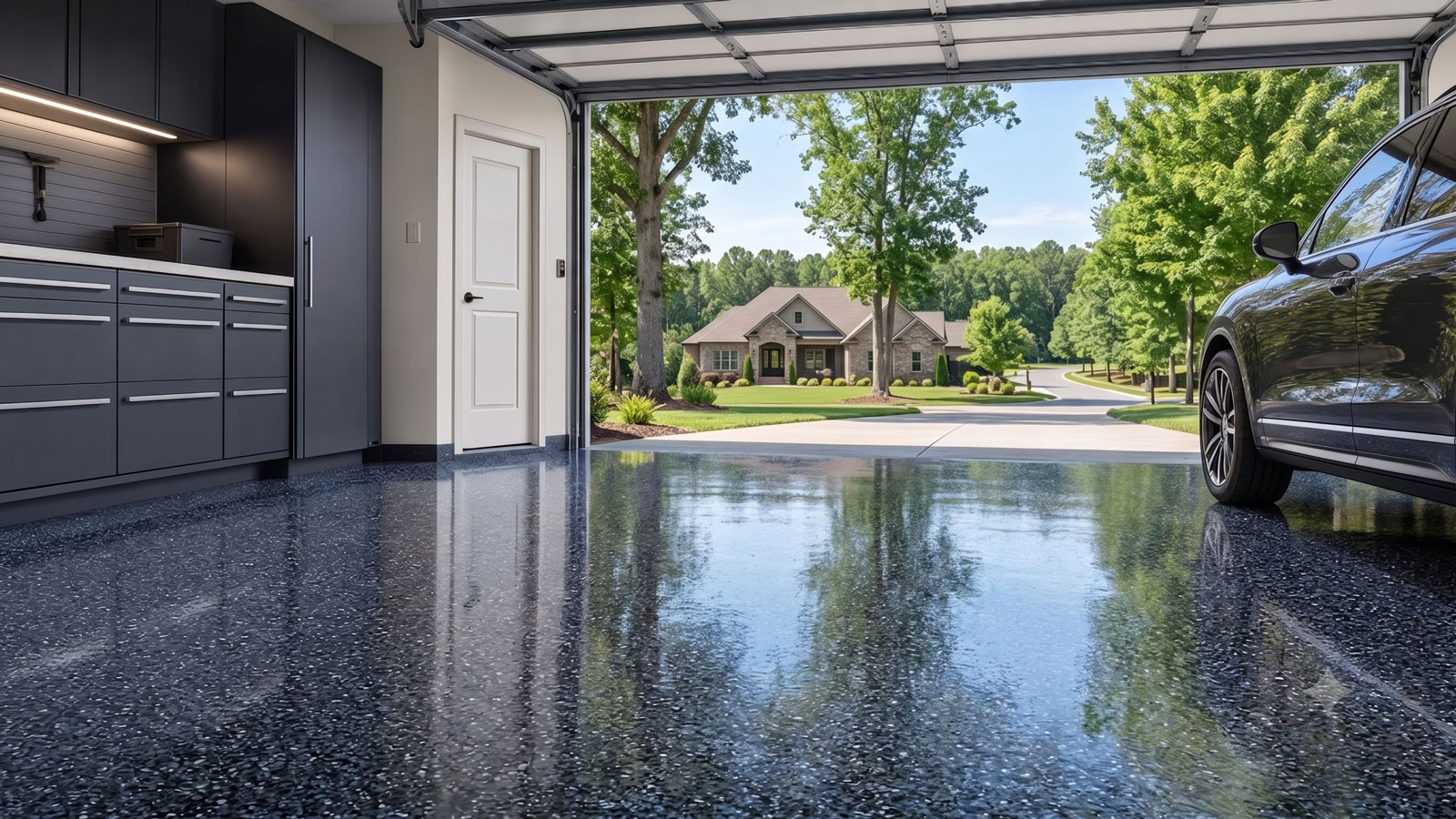
Garage Floor Coating in Porter Ranch, CA
Floor Coating Services in Porter Ranch, CA
Porter Ranch is a newer and more deliberately planned residential environment than many of the older Valley communities in this service area. Porter Ranch includes extensive single-family development, open-space edges, ridgelines, and hillside neighborhoods shaped around the terrain. Its location along the northwestern Valley ridgelines makes slopes and garage thresholds important design questions, but public terrain does not diagnose the concrete at any address.
That newer development pattern can mean newer garage slabs and fewer decades of coatings or patching than an older Burbank or Northridge property, but “newer” does not automatically mean coating-ready. Curing compounds, sealers, smooth machine-finished concrete, and construction residue can still interfere with adhesion if the slab is not mechanically prepared. Porter Ranch is included in Los Angeles's Chatsworth–Porter Ranch community-plan area, distinct from nearby Northridge and Granada Hills planning districts.
The hillside setting adds another local layer. The local terrain includes steep slopes, ridgelines, graded pads, and natural drainage courses. Those same physical conditions make driveway slope and water direction important during a garage-floor estimate. Porter Ranch appears in the Chatsworth–Porter Ranch community-plan area rather than the central-valley community plans. Its northern ridge and hillside setting makes entry grade and runoff worth checking, but public topography does not reveal whether any specific concrete floor is wet or damaged.
Local Market Insight
Porter Ranch often starts with a newer-looking slab, but surface preparation still decides whether the coating lasts. Newer concrete can carry sealers or curing compounds that are invisible until the floor is tested and ground.
What Affects the Cost of Garage Floor Coating in Porter Ranch?
Porter Ranch's planned foothill neighborhoods can contain multi-bay garages and sloped approaches, although neither feature is universal. Cost is driven by actual floor area, prior sealers or curing compounds, crack repairs, door transitions and the effort required for sound surface profiling. Any proven outside drainage defect is a separate issue from choosing an interior coating. Larger garage footprints, hillside access, crack repair, surface hardness, and removal of sealers or curing compounds are the main local variables.
Newer slab surface treatments
A newer-looking floor may still have curing compounds or sealers that must be removed before coating.
Large garages
Porter Ranch includes substantial single-family homes, and larger multi-bay garages increase both material and grinding time.
Hillside access
Sloped streets and driveways can affect equipment staging.
Drainage
The area’s hillside planning puts strong emphasis on natural drainage and erosion control. Garage thresholds should be checked for how water moves during storms.
Cracks
Newer concrete can still crack from shrinkage or movement. Cracks should be evaluated before the coating is installed.
Sun and heat
North Valley sun can be intense. A UV-stable topcoat helps protect appearance near open garage doors.
Call for a clear, project-specific estimate — or request one online.
Newer does not mean coating-ready
A clean-looking Porter Ranch slab can still be a poor bonding surface if it is too smooth or carries a curing compound or sealer. That is why professional mechanical preparation remains necessary even when the garage looks nearly new.
The goal is to expose sound concrete with the correct surface profile, not simply to clean the floor and apply resin over whatever is already there.
Porter Ranch garages are strong candidates for premium decorative systems because many homes have substantial attached garage space and the climate favors year-round residential use.
The technical focus should be on correct mechanical preparation, removal of any bond-breaking treatments, proper crack repair, and a UV-stable wear coat.
Planned-community properties can still contain incompatible sealers, prior coatings, repair joints or vehicle oil. A coating proposal should identify actual preparation, crack repair, exposed-doorway sun and return-to-parking timing rather than assume newer construction always needs less work.
A house in a planned hillside subdivision may have a multi-bay garage, steps or storage alcoves that raise preparation labor even when two quoted floors have similar square footage. Surface coatings, repairs and crack movement still require inspection rather than assumptions based on the community's development date.
During heavy rain, observe whether exterior water flows toward the door or away from it. A new coating cannot correct a poorly graded driveway. Suspicious dampness independent of rainfall calls for evaluation before system selection rather than an automatic expensive moisture-control package.
Hillside planning is part of Porter Ranch
Porter Ranch’s hillside setting makes grading, steep slopes, ridgelines, and natural drainage courses part of the neighborhood’s physical character. Those features are part of the community’s physical character.
For a garage-floor project, the practical translation is simple: look at the driveway and threshold. If runoff moves toward the garage, that should be understood before coating. If access is steep, staging should be planned before installation day.
Where the garage is large, color and flake selection also matter visually because the floor becomes a major surface in the room rather than a small utility area.
At exposed entrances, heat and sunlight can affect coating application and the long-term appearance of some topcoats. Require a written description of substrate profiling, crack work, complete coating layers, finish texture and cure/parking-return time.
In Porter Ranch, a sun-exposed hillside driveway may suggest checking the entry threshold, while another property may present an ordinary level garage entrance. The installer should not use a map to diagnose either condition. Any water that actually crosses the door calls for separate drainage work, and every suitable coating requires a sound prepared slab.
Homeowner Checklist
- Is the slab newer but very smooth?
- Was a sealer or curing product applied when the home was built?
- Is the garage oversized or multi-bay?
- Does the driveway slope toward the door?
- Where does stormwater move during heavy rain?
- Does direct sun reach the floor for long periods?
Porter Ranch Garage Floor Coating FAQs
Why grind a newer Porter Ranch garage floor?
Because adhesion depends on the surface profile, not how clean or new the concrete looks. Grinding removes weak surface material and bond-breaking treatments while opening the concrete for the coating.
Can you coat a garage floor with a builder-applied sealer?
Usually the sealer needs to be removed first. Coating over it can leave the new system bonded to the sealer rather than the concrete.
Do hillside Porter Ranch garages need waterproof coatings?
A floor coating is not a substitute for proper exterior drainage or waterproofing. If water enters the garage, the source should be identified first.
Is polyaspartic useful in Porter Ranch?
Yes, especially as a UV-stable, durable topcoat in garages that receive strong sunlight. The best overall system still depends on the concrete and project requirements.
What should Porter Ranch owners verify on a newer-looking slab?
A clean appearance can conceal curing compounds, sealers or previous coatings. Confirm surface profile, joints, garage geometry, sun at the threshold and a realistic cure schedule before choosing epoxy or polyaspartic.
Porter Ranch Neighborhoods & Local Context
Phone Quote Line
Speak with a floor coating specialist about your project and get a realistic estimate range.
(747) 588-7577Typical Project Cost
$3,000–$5,500
Typical range for a two-car garage. Final pricing depends on floor size, concrete condition, prep work, coating type, and finish options.
Helpful Guides